

First-Line Structured Programmes for ADHD - Non-Pharmacological
First-Line Structured Programmes for ADHD in Patients Who May Not Tolerate Traditional Medication
Key Points
- NICE NG87 recommends pharmacotherapy (stimulants, then atomoxetine) as first-line for adult ADHD, with psychological therapies as second-line; however, this sequencing was based on only one RCT and is now considered outdated[1][2]
- CBT is the most evidence-based non-pharmacological intervention for adult ADHD, with meta-analyses showing sustained efficacy on core symptoms for at least 12 months (effect sizes d = 0.8-1.4 in adjunctive trials)[3][4][5]
- CBT alone (without medication) has shown significant improvements in ADHD symptoms and functioning comparable to combined CBT + dextroamphetamine in at least one RCT[6]
- Psychoeducation is effective and serves as a foundational intervention, improving ADHD symptoms and knowledge, and may be sufficient for patients with milder presentations[7]
- DBT-adapted for ADHD shows promise for patients with prominent emotional dysregulation and comorbid features; it addresses the emotion regulation gap where stimulants are less effective (ES 0.3-0.5 for emotional dysregulation vs ~0.8 for core symptoms)[8][1]
- Goal Management Training (GMT), combining executive function rehabilitation with mindfulness, specifically targets inhibitory control and organisational skills[9]
- The European Consensus Statement (Kooij et al. 2019) recommends multimodal treatment including psychoeducation, CBT, coaching, and skills training alongside or instead of pharmacotherapy[10][11]
- Occupational therapy and coaching are increasingly recognised as important for functional improvement beyond symptom reduction, though the evidence base is still developing[12]
──────────────────────────────────────────────────
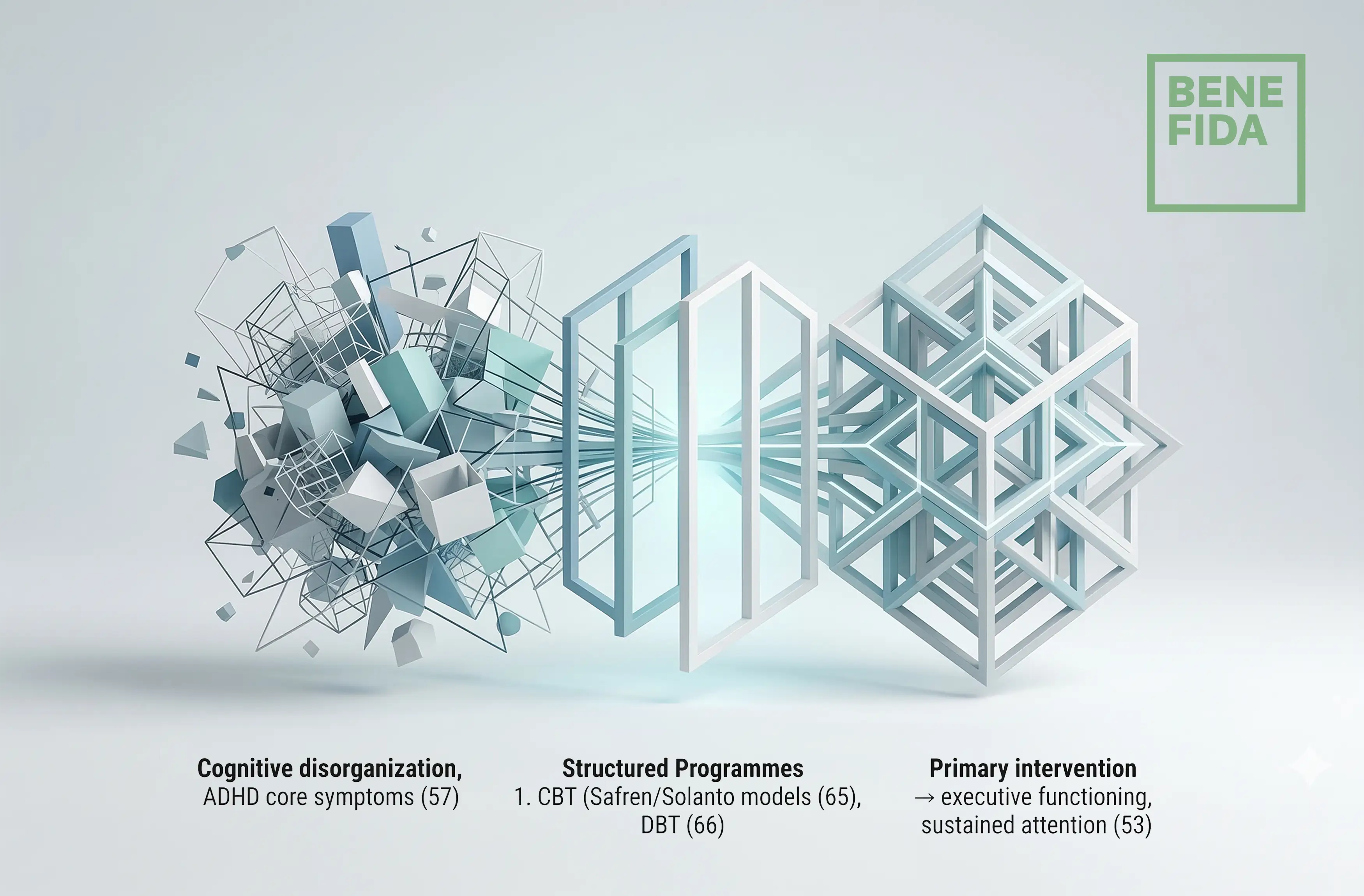
Guideline Position: Where Non-Pharmacological Fits
NICE NG87 (2018)
NICE recommends pharmacotherapy as first-line for adults with ADHD, with psychological therapies (specifically CBT) as second-line[1][5]. Crucially, this sequencing was based on a single RCT (Safren et al. 2010) and a literature search up to April 2017[1]. Since then, multiple RCTs have demonstrated significant efficacy of non-pharmacological interventions for core symptoms and associated dysfunctions[2]. NICE was unable to recommend specific types of non-pharmacological treatment due to paucity of head-to-head trials, which is "highly problematic in particular for those patients who do not opt for or are unable to tolerate a pharmacologic treatment"[2].
Non-pharmacological treatment for ADHD does not necessarily require a formal diagnosis and may present a lower-risk therapeutic option, particularly for patients with milder presentations or medication intolerance[13].
European Consensus (Kooij et al. 2019)
The updated European Network Adult ADHD consensus recommends a multimodal approach incorporating psychoeducation, CBT, coaching, and structured skills training either alongside or as an alternative to pharmacotherapy[10][11]. Pharmacological and non-pharmacological treatments are explicitly framed as complementary rather than mutually exclusive[1].
──────────────────────────────────────────────────
Structured Programmes with Evidence
1. CBT for Adult ADHD (Strongest Evidence)
CBT is currently the best-supported non-pharmacological treatment for adult ADHD[5][14].
Safren Model (Massachusetts General Hospital)
- 12 individual sessions across 3 core modules: organising/planning, managing distractibility, and cognitive restructuring (adaptive thinking)[4][15]
- 3 optional supplementary modules: procrastination, anger/frustration management, communication skills[4]
- The landmark RCT (Safren et al. 2005, N=31) found CBT + medication significantly superior to medication alone, with a large effect size (d = 1.4)[16]
- A larger RCT (Safren et al. 2010, JAMA, N=86) confirmed CBT superiority over relaxation with educational support in medicated adults with residual symptoms[6][17]
- Effects sustained at 12-month follow-up[3][17]
Solanto Meta-Cognitive Therapy (MCT)
- Group format targeting self-management of attention, time, and organisation
- RCT (Solanto et al. 2010, Am J Psychiatry) found significant benefits for inattention symptoms specifically[18][19]
Group CBT
- 12-week group CBT (6 modules: psychoeducation, organisation/planning, coping with distractibility, cognitive restructuring, procrastination management) has been validated in multiple settings[3][20]
- Meta-analyses show efficacy across self-reported ADHD core symptoms, emotional symptoms, self-esteem, social function, and time management[3]
CBT as Monotherapy (Without Medication): One RCT (Weiss et al. 2012) found improvements in ADHD symptoms and functioning with CBT alone, with no significant differences between CBT alone and CBT combined with dextroamphetamine, suggesting CBT can be a viable standalone option[6].
2. DBT-Adapted for ADHD
DBT was originally developed for BPD but has been adapted for adult ADHD, particularly for patients with prominent emotional dysregulation[8][15]. This is particularly relevant because stimulant medication has a lower effect size for emotional dysregulation (ES ~0.3-0.5) than for core symptoms (ES ~0.8)[1].
- The Hesslinger model combines DBT skills (mindfulness, distress tolerance, emotion regulation) with ADHD-specific psychoeducation and organisational strategies[15][8]
- Hirvikoski et al. (2011) conducted an RCT of a structured DBT skills training group for adults with ADHD, showing significant symptom reduction[6]
- A combined CBT-DBT approach (Nasri et al.) integrates cognitive restructuring with dialectical acceptance strategies[6]
3. Psychoeducation
Structured psychoeducational programmes demonstrate positive outcomes in adults with ADHD, improving knowledge, symptom self-management, and treatment engagement[7]. Psychoeducation often forms part of other programmes and may alleviate symptoms in its own right[8].
4. Goal Management Training (GMT)
A group-based cognitive rehabilitation programme that targets executive functioning through problem-solving skills, inhibition strategies, and mindfulness techniques for sustained attention[9]. GMT is theoretically well-matched to ADHD because it directly addresses executive dysfunction, considered by many a core deficit in ADHD[9].
5. Coaching and Occupational Therapy
The UK Adult ADHD Network consensus statement (2021) highlights that symptom reduction alone does not always produce improvement in daily functioning[12]. ADHD coaching and occupational therapy interventions are increasingly recognised for addressing real-life functional challenges (time management, organisation, participation) that persist even after pharmacological or psychological symptom reduction[12].
──────────────────────────────────────────────────
Summary Table: Non-Pharmacological Programmes for Adult ADHD
──────────────────────────────────────────────────
Practical Recommendations for Patients Who Cannot Tolerate Medication
For adults with ADHD who cannot tolerate pharmacotherapy, a stepped approach based on current evidence could include:
- Foundation: Structured psychoeducation (individual or group)
- Primary intervention: CBT for adult ADHD (Safren or Solanto model), ideally 12 sessions targeting organisation, distractibility, and cognitive restructuring
- If prominent emotional dysregulation: Consider DBT-adapted skills training or combined CBT-DBT
- Adjunctive: ADHD coaching, occupational therapy for functional goals, and mindfulness-based techniques
- Exercise: Mindfulness-based exercise (yoga/tai chi combined with meditation) showed the largest effect sizes for improving attention in network meta-analysis data
Book your first consultation with BeneFida today - and let’s find what works for you.















.jpg)